italiano
 English
 français
 Deutsch
 русский
 español
 português
 العربية
 Nederlands
 한국의
한국의 Romania
 Bulgaria
 Melayu

L'essenza di un elettrolizzatore cloro-alcali Si tratta di un reattore elettrochimico a controllo preciso. La corrente continua fluisce attraverso l'anodo ed esce attraverso il catodo. All'interno di uno spazio estremamente ristretto, la salamoia viene decomposta in cloro gassoso, idrogeno gassoso e soda caustica. A guidare tutto ciò sono tre componenti principali, progettati con precisione, che lavorano in sinergia: l'anodo, il catodo e la membrana a scambio ionico.
L'anodo è il punto in cui gli ioni cloruro cedono i loro elettroni. L'anodo di un moderno elettrolizzatore cloro-alcali è costituito da una rete metallica espansa di titanio, con un rivestimento superficiale di ossidi metallici misti spesso solo pochi micrometri. Il titanio viene scelto come materiale di base perché, nelle condizioni di polarizzazione anodica dell'elettrolisi, si forma spontaneamente sulla sua superficie un denso film di passivazione di biossido di titanio (TiO₂). Questo film è estremamente stabile in presenza di cloro gassoso umido e salamoia concentrata. Tuttavia, sebbene il film di passivazione protegga il titanio dalla corrosione, ne riduce anche la conduttività elettrica. Pertanto, sulla superficie del titanio viene spruzzato un rivestimento catalitico di dimensioni micrometriche. Il componente principale del rivestimento è il biossido di rutenio (RuO₂), un ossido con conduttività di livello metallico. La funzione di lavoro del RuO₂ rientra precisamente nel band gap del TiO₂, formando un "ponte conduttivo" all'interno del film di passivazione del TiO₂ che permette agli elettroni di passare dall'elettrolita attraverso il film di passivazione al substrato di titanio. Allo stesso tempo, il RuO₂ presenta un'attività catalitica estremamente elevata per la reazione di evoluzione del cloro (2Cl⁻ → Cl₂ + 2e⁻). Alla stessa tensione, la velocità di generazione del cloro è di gran lunga superiore alla velocità di generazione dell'ossigeno, migliorando l'efficienza di corrente. Tuttavia, un rivestimento di RuO₂ puro si dissolve lentamente durante il funzionamento a lungo termine in un anolita acido (pH 2-4). Pertanto, il biossido di iridio (IrO₂) viene aggiunto al rivestimento degli anodi dimensionalmente stabili (DSA) commerciali. Il biossido di iridio è molto più stabile dell'ossido di rutenio binario in ambienti acidi, prolungando la durata del rivestimento. Alcune formulazioni contengono anche SnO₂ come stabilizzante e disperdente. I rivestimenti anodici delle celle a diaframma contengono in genere più SnO₂ perché l'anolita della cella a diaframma ha un pH più elevato, creando una maggiore necessità di sopprimere la reazione secondaria di sviluppo di ossigeno.
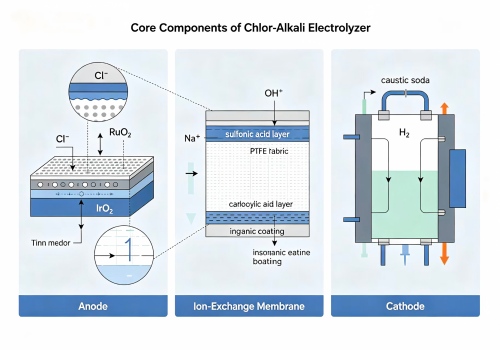
Il moderno membrana cloro-alcalina È un materiale composito polimerico perfluorurato costituito da quattro strati funzionali: lo strato più spesso è quello di acido solfonico, rivolto verso l'anodo. L'acido perfluorosolfonico (-SO₃H) è un superacidio. Questo strato ha un elevato contenuto di acqua e gli ioni sodio lo attraversano senza ostacoli; è il principale strato conduttivo della membrana, fornendo un percorso a bassa resistenza. Dietro lo strato di acido solfonico è incorporato un tessuto in PTFE che fornisce lo scheletro meccanico. L'inerzia chimica della catena perfluorocarbonica conferisce alla membrana durabilità nel duplice ambiente estremo di condizioni fortemente ossidanti e fortemente alcaline. Lo scheletro in PTFE garantisce inoltre che la membrana non subisca creep termico durante il funzionamento ad alta temperatura. Il restringimento o l'espansione localizzati della membrana causerebbero variazioni nello spazio con gli elettrodi, portando a una densità di corrente locale incontrollata. Rivolto verso il catodo si trova lo strato di acido carbossilico; l'acido perfluorocarbossilico (-COOH) è un acido debole. Sul lato anodico acido e ricco di acqua, il gruppo -COOH rimane parzialmente come molecola neutra, con i canali ionici semiaperti; sul lato catodico alcalino e povero di acqua, il gruppo -COOH si dissocia completamente in -COO⁻, e la densa carica negativa forma una barriera di esclusione di Donnan che impedisce la migrazione inversa degli ioni OH⁻. Lo strato più esterno è un rivestimento inorganico spesso pochi micrometri (tipicamente ossidi porosi come ZrO₂). Formando una struttura superficiale porosa e ruvida, riduce l'adesione della superficie della membrana alle bolle, consentendo al cloro e all'idrogeno gassosi prodotti dall'elettrolisi di staccarsi rapidamente dalla superficie della membrana. Una singola membrana di acido solfonico non ha una densità di carica negativa sufficiente per bloccare efficacemente la migrazione inversa degli ioni OH⁻. La concentrazione di OH⁻ nel catolita è molto più alta di quella nell'anolita, e l'eccessivo gradiente di concentrazione spinge gli ioni OH⁻ a migrare all'indietro attraverso la membrana verso l'anodo, riducendo notevolmente l'efficienza di corrente. Questo problema è stato successivamente risolto laminando uno strato di acido carbossilico sullo strato di acido solfonico. La densità di carica negativa del gruppo -COO⁻ nello strato di acido carbossilico è di gran lunga superiore a quella del gruppo -SO₃⁻, aumentando la repulsione del gruppo OH⁻. Sebbene la resistenza totale della membrana aumenti leggermente, l'efficienza di corrente balza dall'80% al 96-97%.
Questi tre componenti fondamentali dell'elettrolizzatore cloro-alcali rappresentano tre dimensioni della ricerca e dello sviluppo: la durabilità degli anodi rivestiti elettrocataliticamente in ambienti fortemente ossidanti; la stabilità dei catodi catalitici ad elevata superficie specifica in soluzioni fortemente alcaline; e l'efficiente selettività ionica delle membrane perfluorurate in presenza di gradienti di pH estremi.
1. Perché l'anodo di titanio necessita di un rivestimento di ossido metallico misto?
Un film di passivazione naturale di TiO₂ sul titanio previene la corrosione ma perde la conduttività. Il rivestimento composito RuO₂-IrO₂ crea un ponte conduttivo, fornisce un'elevata attività catalitica per l'evoluzione del cloro e migliora la stabilità in ambiente acido.
2. Qual è la funzione di IrO₂ e SnO₂ nei rivestimenti anodici?
L'IrO₂ migliora la resistenza agli acidi a lungo termine del rivestimento, prevenendone la dissoluzione. L'SnO₂ agisce come stabilizzante e disperdente, contribuendo a sopprimere le reazioni collaterali di sviluppo di ossigeno nelle cellule del diaframma.
3. Perché la membrana cloro-alcalina adotta una struttura a doppio strato composta da acido solfonico e acido carbossilico?
Lo strato di acido solfonico garantisce un'elevata conduttività ionica e una bassa resistenza. Lo strato di acido carbossilico forma una forte barriera di esclusione di Donnan per bloccare la migrazione inversa degli ioni OH⁻, migliorando notevolmente l'efficienza di corrente dall'80% al 96%-97%.



 IPv6 RETE SUPPORTATA